What 3D modelling actually teaches a kid (beyond "making cool stuff")
22 September 2026 · 4 min read
Ask a parent what “3D modelling” means and most guess it’s the digital equivalent of a craft class — kids making little dragons and spaceships on a screen. That’s not wrong, exactly. It’s just the visible 10% of what’s actually happening.
The real skill underneath: spatial reasoning
Building a 3D object means constantly holding two things in your head at once — what a shape looks like from the angle you’re looking at, and what it actually is from every other angle you’re not looking at right now. A cylinder that looks like a circle from the top has to still be a cylinder when you rotate the view. This sounds obvious to an adult who’s done it for years. It is not obvious to a first-time 10-year-old, and getting comfortable with it is a real, measurable jump in spatial reasoning — the same skill that shows up later in geometry, engineering, and reading technical drawings.
The part that actually hooks kids: it becomes real
At NOVA, a design doesn’t stay trapped on a screen. Once a model is finished, it goes to a 3D printer and comes out as an object you can pick up, turn over, and hand to someone. We’ve had students design something in an afternoon and be holding the physical result before their parent picked them up. That loop — design it, then hold it — is what turns “I made a shape” into “I made a thing,” and it’s usually the moment a kid stops treating the software like a toy and starts treating it like a tool.
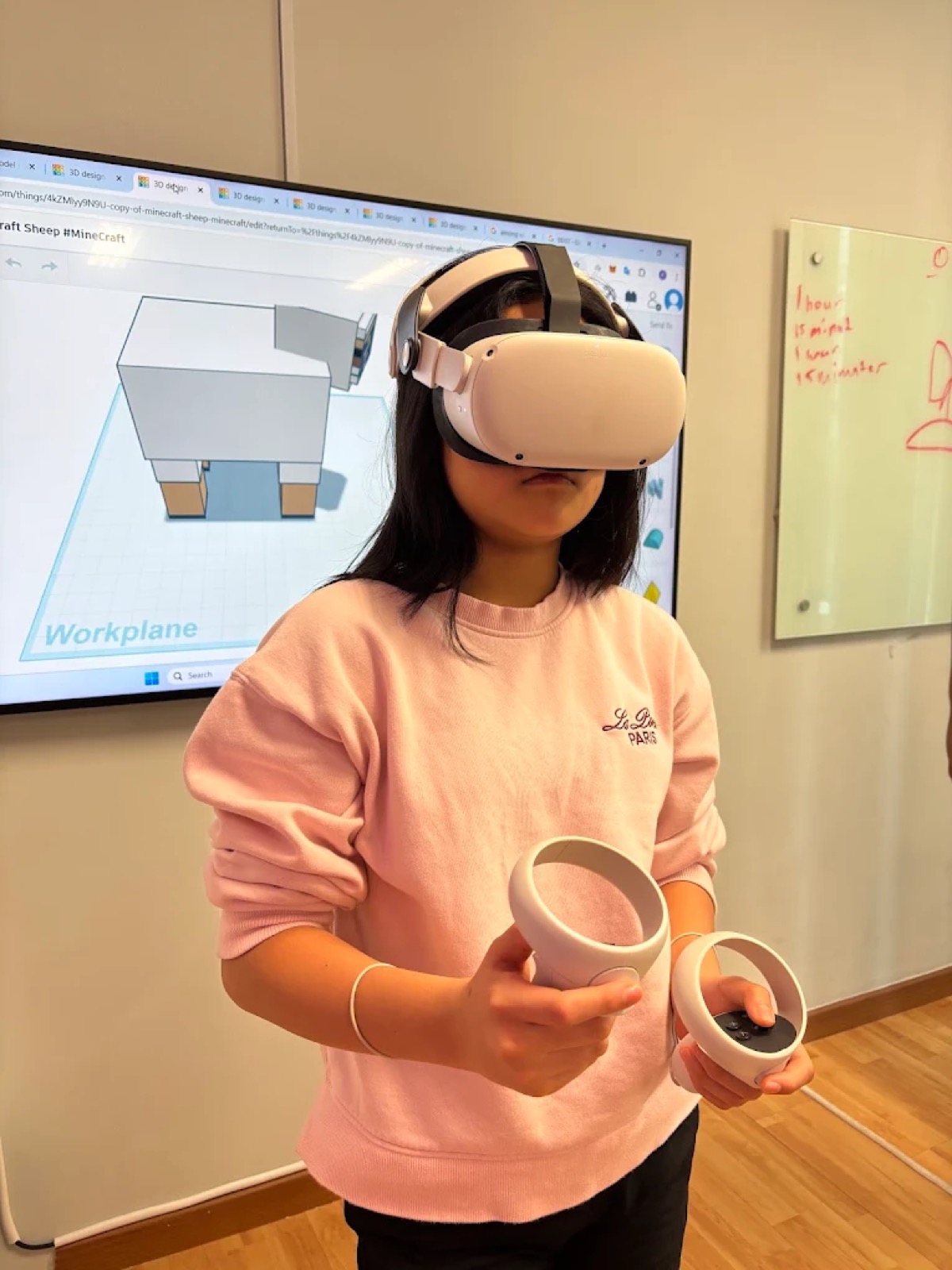
Some students go further and check their work in VR, walking around a model at full scale instead of just rotating it on a flat screen — the same spatial-reasoning skill, just with nowhere to hide from a proportion that’s actually wrong.
Why it’s not “just” an art elective
3D modelling is the same underlying skillset used in game asset design, product design, architecture visualization, and increasingly in AI-driven design tools that still need a human who can judge whether a generated shape actually makes sense in space. A student who’s comfortable in a 3D viewport at 12 has a head start on all of those, whether or not they ever call themselves “an artist.”
What it looks like at NOVA
3D Modelling & Animation runs across our Junior Computer Academy tracks, building from a single simple shape toward a full designed object — the same way our Student Work page shows real students’ actual models and prints, not renders borrowed from somewhere else. If your child likes building things with their hands — LEGO, Minecraft, drawing — this is usually the fastest “yes, I like this” of any course we run, because it starts from exactly that same instinct.
Curious whether it clicks for your child specifically? A free trial class is the fastest way to find out — most kids know within the first twenty minutes whether they want to keep building.