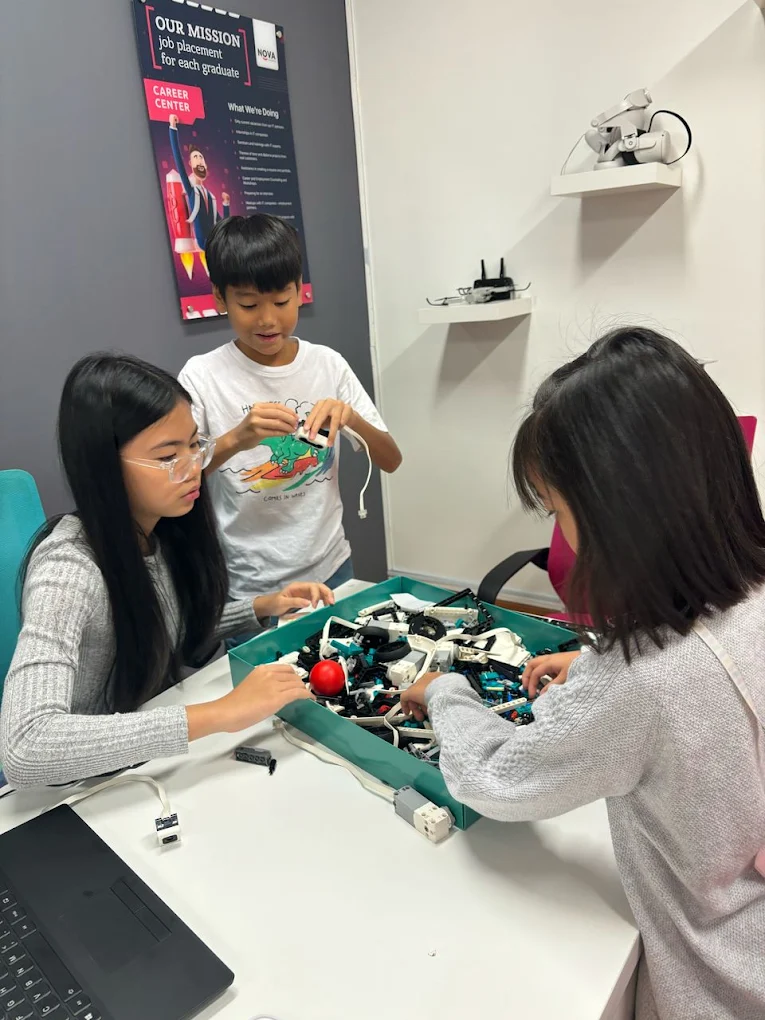
Parents usually frame this as picking a “track” — as if robotics and coding are two separate destinations. In practice they’re not competing tracks; they’re two different entry doors into the same skill set, and one of them suits most beginners better.
What robotics actually teaches first
Robotics starts physical: a child builds something with their hands — a LEGO-based robot, a sensor, a moving part — before any code is involved. The “programming” comes after, and it’s immediately visible: write the instruction, and the robot moves, turns, or stops in front of you. There’s no abstraction gap between cause and effect.
This is why robotics tends to work well for younger children or kids who lose interest fast when feedback is delayed. A LEGO robot that drives into a wall because of one wrong instruction is a more immediate, satisfying failure to debug than a silent syntax error on a screen.
What coding actually teaches first
Pure coding — Scratch-based visual logic, then eventually typed languages — starts abstract. There’s no physical object; the feedback loop is a character moving on screen, a website appearing, or a game responding to a key press. It asks a child to hold a sequence of steps in their head without a physical prop to lean on.
This suits children who are already comfortable with screens and enjoy the idea of building a game or app more than building an object. It’s also the more direct path if the end goal is something like a portfolio website, a working Python program, or a finished game — those live entirely in software, and robotics doesn’t build toward them as directly.
The actual deciding factor: not age, attention style
Age matters less here than people assume — we’ve had 5-year-olds thrive in coding-first tracks and 12-year-olds who needed the physical entry point robotics provides. The better question is how your child currently prefers to solve problems:
- Prefers building, taking things apart, seeing immediate physical results → robotics first.
- Prefers screens, games, and is comfortable with delayed/abstract feedback → coding first.
Neither choice is permanent or exclusive. NOVA’s own Junior Computer Academy tracks don’t force a binary choice — robotics (LEGO builds, Arduino electronics) and coding (Python, game development) both appear across the same multi-year curriculum, in a deliberate sequence, precisely because most students benefit from both, just not necessarily in the same order or at the same pace.
What we’d actually tell a parent asking this
If you genuinely have to pick a starting point for a first exposure: robotics is the lower-risk choice for a child with no prior interest signal either way, because the physical feedback loop keeps attention longer for a true beginner. Coding is the better starting point if your child has already shown interest in games, apps, or “how do websites work” — that curiosity is worth pointing directly at the thing they’re already curious about.
If you’re still unsure which fits, a free trial class exposes your child to both in a single session — which tends to answer the question faster than guessing from a description on a website ever will.